

1. Understanding the Airflow Mechanism of 3D Spacer Fabrics
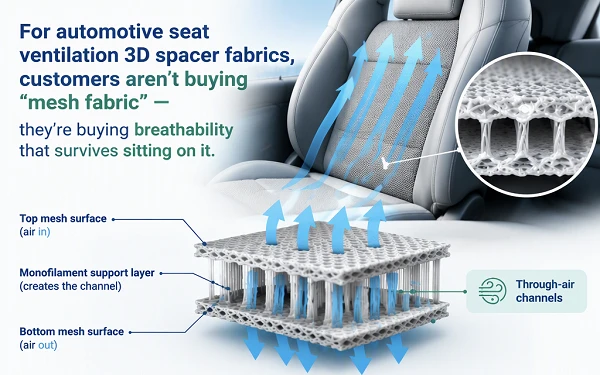
A typical 3D warp-knitted spacer fabric consists of two knitted mesh surfaces connected by an intermediate layer of monofilaments.
The two outer surfaces provide the fabric's mesh structure, while the connecting monofilaments maintain the separation between them. Together, these components create interconnected voids and through-air pathways that allow air to move through the fabric.
The thickness of a spacer fabric contributes to its available internal space, but thickness alone does not determine ventilation performance. Mesh opening size, structural uniformity, internal channel connectivity, and resistance to compression all influence airflow.
When an external load compresses the fabric, the distance between the two surfaces decreases and the internal geometry changes. If the supporting structure deforms excessively, airflow pathways may become restricted.
Consequently, the performance of an automotive spacer fabric should be assessed not only in its unloaded state, but also under representative compression conditions.
2. Knitting and Stentering: Balancing Mesh Opening and Structural Stability
In warp-knitted spacer fabric production, the surface mesh may require a subsequent stentering process to achieve the intended opening geometry and dimensional stability.
The stentering conditions must be carefully controlled because changes in fabric width, tension, overfeed, and heat exposure can influence the final structure.
Insufficient mesh opening
If the surface mesh remains too closed, the effective openings available for air passage may be reduced. This can limit the fabric's airflow potential even when its nominal thickness appears adequate.
Excessive stretching
Excessive stretching can alter the geometry of the mesh and the connecting monofilaments. Depending on the fabric construction and processing conditions, this may affect structural stability and compression resistance.
Uneven processing
Variations in tension or overfeed across the fabric width can contribute to differences between the edge and center regions. Such nonuniformity may lead to variations in thickness, mesh geometry, and airflow across cut panels.
The objective is therefore not simply to maximize mesh opening. It is to achieve a consistent, open structure while maintaining sufficient support and dimensional stability.
3. Heat Setting: Stabilizing the Fabric Structure
Heat setting is an important stage in the processing of many polyester-based spacer fabrics. It helps stabilize the fabric dimensions and retain the intended mesh geometry.
However, the final mechanical behavior of a spacer fabric depends on more than the dimensional stability achieved during heat setting.
Thermal exposure, knitting conditions, monofilament geometry, and interactions within the knitted structure can all influence the mechanical response of the finished material. The properties measured on raw PET monofilament therefore should not be treated as direct substitutes for finished-fabric performance.
For automotive applications, evaluating the processed fabric provides a more relevant understanding of how the material behaves in service.
Where performance requirements are demanding, comparisons should be made under consistent processing and testing conditions.
4. PET Monofilament Selection: Supporting Air Channels Under Compression
PET monofilament is a key structural component of 3D spacer fabrics. Its role is not limited to providing tensile strength; it also contributes to the spacer layer's ability to maintain separation between the two mesh surfaces.
Monofilament diameter, mechanical properties, and geometry must be considered together with the fabric construction and processing conditions.
Monofilaments that are too fine
Depending on the structure and loading conditions, finer support elements may be more susceptible to bending or buckling. Excessive compression can reduce the internal space available for airflow and increase the risk of the fabric reaching an undesirably low thickness.
Monofilaments that are too coarse
Larger monofilaments may provide greater structural support in some constructions, but they can also increase fabric stiffness and affect seating comfort. A larger diameter does not automatically result in better overall performance.
The importance of compression recovery
For automotive seat ventilation, the ability of the fabric to recover after unloading is an important consideration. The fabric must balance support, flexibility, resilience, and the retention of its internal air channels.
Rather than selecting PET monofilament based on tensile strength alone, developers should consider how the monofilament performs within the knitted and heat-set structure.
The appropriate balance depends on the application, the spacer fabric design, the intended seating load, and the required comfort characteristics.
5. Evaluating Finished-Fabric Performance: Two Important Measurements
To connect material selection with actual application requirements, finished-fabric testing can provide more useful information than raw material specifications alone.
Two measurements are particularly relevant to automotive seat ventilation development.
Airflow Retention Under Compression
Air permeability can be measured under defined conditions before and during compression. Comparing the results helps determine how much airflow capacity is retained when the spacer fabric is subjected to a simulated seating load.
For meaningful comparisons, the applied pressure, specimen dimensions, conditioning, and test method should be kept consistent.
The results can help identify whether a fabric maintains sufficient internal air pathways under load, rather than performing well only in its unloaded state.
Thickness Retention After Repeated Loading
Repeated compression testing can help evaluate the fabric's resistance to deformation and its ability to recover after loading.
Measurements may include thickness under load, residual thickness after unloading, and changes in thickness after a defined number of compression cycles.
These results provide insight into structural durability and recovery behavior. However, they should be interpreted alongside the fabric's comfort requirements and airflow performance, since maximum thickness retention alone does not guarantee the best seating experience.
Together, airflow retention and thickness recovery offer a more application-oriented assessment of spacer fabric performance.
6. Integrating Fabric Structure, Processing, and Material Selection
The performance of a 3D spacer fabric cannot be attributed to a single parameter in isolation.
Mesh structure establishes the potential airflow pathways. Stentering and heat setting influence the geometry and stability of those pathways. PET monofilaments provide the internal support needed to maintain the separation between the two mesh surfaces under load.
These factors interact throughout manufacturing and during the fabric's service life.
For automotive seating developers, the most effective approach is to evaluate the complete material system under representative processing and loading conditions. This helps connect monofilament selection and fabric construction with the finished product's requirements for ventilation, cushioning, resilience, and durability.
Conclusion
For 3D spacer fabrics used in automotive seat ventilation, the key challenge is not simply achieving high air permeability in an unloaded specimen. It is maintaining useful airflow while preserving structural support and comfort under compression.
A balanced approach to mesh formation, heat setting, and PET monofilament selection can help manufacturers develop spacer fabrics that better meet these requirements.
Ultimately, the relevant question is not only how breathable a spacer fabric is when new, but how well its airflow pathways are maintained under the conditions it is designed to withstand.
For material suppliers and fabric developers, evaluating airflow retention under compression alongside thickness recovery after repeated loading provides a practical starting point for application-focused product development.