

Nantong NTEC Monofilament Technology Co.,LTD is a national high-tech enterprise focusing on research and development, production and sales of polymer monofilament. NTEC has two large fields of business including monofilament yarn and polymer line and wires. For Polymer line and wires, NTEC focuses on research and development of sports leisure and modern agriculture with grass trimmer line, fishing line, polyester wire (belt), tennis string, badminton string, etc.
Strong Production Capability
The company covers an area of 65000 square meters, with construction area of 116000 square meters and 218 advanced large diameter functional polymer drawing production lines, ranking first in production scale and market share in this field.
Quality Assurance
We have obtained IOS9001 system certification, SGS factory certification, GRS, SGS, MSDS, Oeko-Tex and other product certification.
Broad Market
The company has a professional sales team of nearly 100 people serving the global market. Its products cover more than 20 provinces and cities including Jiangsu, Shanghai, Zhejiang, and are exported to countries and regions such as the United States, Japan, Europe, and Southeast Asia.
Leading Service
Our services are refined and standardized. From pre-sales technical consultation to after-sales maintenance, we always put customer needs first and continuously innovate our service value system.


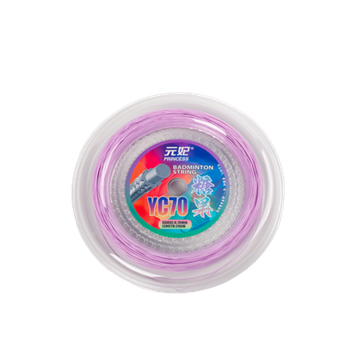


What is Badminton String
Badminton strings are an important component that determines the characteristics of the racket and directly affects the player's performance on the court. The type and tension of the string have a great impact on the game, so choosing the right string is crucial.
Features of Badminton String
Wear Resistance
As the name suggests, it refers to whether a ball line is easy to pilling. In fact, there are cases where it breaks directly without pilling, and there are cases where it breaks for a long time after pilling. The previous product structure was relatively simple, and it can be said that wear resistance is life. Now the product structure is becoming more and more complex, so it should be translated as "durability" to be more accurate.
Control
In my opinion, it is the special thread/coating technology and other buffs. Among the three major control models of Y, the surface of the 99 line is concave-convex fiber, and the vertical line of AB ABB is PU coating, which has a rosin-like sticky feeling. These are helpful to instantly transmit a greater and more delicate hitting force to the ball head at the moment of contact with the ball, so that some shots like lobs, net rubbing, etc., fall more accurately or the ball head rolls more violently.
Shock Absorption
That is, the ability of a ball line to avoid pits and "shock hands". I tried to define the shock hand as a ball line with too "high frequency", that is, the line bed feels too wooden when playing. The ball line with good shock absorption performance, at the microscopic level, is that under the same conditions, the ability to deform under force is relatively strong, and the recovery speed is relatively fast. To achieve this, basically at present, it is achieved by reducing the line diameter. It can be said that more than 90% of the lines with good shock absorption are thin lines.
Types of Badminton String
Badminton strings come in a variety of materials and thicknesses, each with specific properties that set them apart from one another. String materials include natural gut, synthetic gut, multifilament, or synthetic.
Natural Gut Strings
Natural gut strings are the highest quality strings that provide players with an excellent sense of power, comfort, and control. These strings are natural and made from animal gut, known for their excellent elasticity and provide a more consistent feel when hitting the shuttlecock. While natural gut strings offer the best feel, they are expensive and prone to wear and tear, making them less durable than synthetic strings.
Synthetic Gut Strings
Synthetic gut strings are also known as nylon strings. They are popular because they offer a low-cost alternative to natural gut strings. Synthetic gut strings are very durable and provide a consistent and responsive feel. Although synthetic gut strings do not feel as good as natural gut strings, they are still a good choice for beginners due to their affordability and durability.
Multifilament Strings
Multifilament strings are much more advanced than synthetic gut strings because they are made from a combination of many synthetic, natural, or multiple materials. These fibers are micro-woven together to form the final product. Multifilament strings are more elastic and provide better shock absorption, which reduces the risk of injury. They have a softer, more comfortable feel than synthetic strings.
Synthetic Strings
Synthetic strings are for players who want a combination of durability and power. They are made from durable materials and feel sturdier, providing players with more power. Synthetic strings are a great choice for players who hit the ball hard and aggressively but need a more durable string than natural gut.

The choice of badminton string should depend on your standards, playing style, personal preferences and budget.
Standards
A thinner string (0.68mm or thinner) is for more advanced players - this is because it will provide more control, feel and repulsion against the string bed.
A thicker string (0.70mm or longer) is for intermediate/beginners - this is because it will provide more durability and may allow you to generate more power. You are also less likely to feel the benefits of a more advanced string!
Budget
If you can't feel a huge difference between strings, then it makes sense to go for a thicker string. This will be more durable, help you break less strings, and reduce the cost of replacing strings!
Some Ways to Protect Badminton Strings:
Store your rackets in a place where there are no extreme temperature changes. Both extreme heat and cold can affect the durability and lifespan of your badminton strings.
Extreme heat can cause badminton strings to stretch, which reduces tension and results in a poor playing experience. Even when the temperature drops back to room temperature, the badminton strings will not fully return to their original tension because the molecules within the strings have been permanently altered by the extreme temperature. So if you live in a particularly hot place, avoid storing your rackets in the trunk of your car—on a sunny day with no air circulation, the temperature inside a car can sometimes be 40-60ºF hotter than outside. Also, you'd better avoid storing your rackets near heaters or vents in your home.
Extreme cold can make badminton strings hard and brittle, making them more likely to break. If you're traveling to the badminton hall from a cold place, a little patience may be your best option to prevent your badminton strings from being damaged by their brittleness. Take the time to let the badminton strings thaw and warm up in the badminton hall instead of playing directly on the court. In terms of storage, if you live in a particularly cold area, avoid storing your racket in the trunk of your car and don't leave it on the floor in your garage or basement, as these places tend to be particularly cooler than the rest of your home.
Keep the strings away from sharp or hard objects. Badminton players tend to keep all their badminton materials in a separate carrying container, i.e. a badminton bag or backpack. The biggest risk of badminton strings breaking is from friction with sharp or hard objects such as keys or even mobile phones. The simple solution here is to separate your rackets from other personal belongings and equipment by dedicating a compartment in your badminton bag to rackets and placing each racket individually in its own racket case.
Practice consistency in your shots. Similar to protecting your racket, consistency in your shots plays an important role in protecting your strings. Within the string bed, there is an ideal oval-shaped area known as the "sweet spot" that players should aim for. Not only does this allow you to hit the best shots, but this is also where the string bed is most resilient. Players who don't have a good grasp of the timing of their shots are more likely to mis-hit the ball, which usually manifests as shots along the outer edge or perimeter of the string bed, closest to the racket frame. Outside of the sweet spot, the string bed is much less resilient and more likely to break because there is less space and distance for the shuttlecock's power to be evenly distributed across the string bed.
Avoid hitting slice shots. Slices are advanced technical shots that involve cutting or brushing the strings of the shuttlecock at an angle. While these shots are impressive and can become a must-have skill for players, they do accelerate string wear because slices put pressure on the strings through contact. Cutting wears away the outer coating of the strings, causing abrasions and eventually causing the strings to break completely.
Maintain Badminton Strings by:
1. Check and replace grommets regularly. Grommets are designed to provide a path for the badminton strings to pass through to prevent them from coming into contact with the racket frame. This helps prevent the badminton strings from putting pressure on the racket frame, which can cause it to collapse. However, the grommets also serve to protect the badminton strings. The racket frame is made of a hard graphite material that also puts pressure on the badminton strings. Due to the sharp edges, the badminton strings can begin to get cut or torn, eventually causing the badminton strings to break altogether.
Always check if the grommets are worn and work with your stringer to replace them as needed. While most professional stringers will naturally check your string grommets when they restring your racket, as a racket owner, you should also take on the responsibility of doing your due diligence on a regular basis.
2. Pick up the shuttlecock by hand instead of scooping it up with your racket. When the shuttlecock hits the ground, badminton players tend to scoop the shuttlecock off the ground to start the next round. This is quick and convenient, and the player doesn’t have to bend over to pick up the shuttlecock with their hands. You might be thinking, why would I change something so convenient, and that seemingly every badminton player does? The answer is - to some degree, scooping up a shuttlecock from the ground causes your racket to come into contact with the floor. This repetitive motion increases wear on the loops or strings, and can accelerate their breakage. Many of today's standard badminton rackets protect the strings on the outside of the racket frame, but there are still areas where the strings are exposed to the ground, especially when turning the racket at an angle to pick up the shuttlecock.
Certifications


Frequently Asked Questions
We're well-known as one of the leading badminton string manufacturers and suppliers in China. Please feel free to wholesale high quality badminton string at competitive price from our factory. Also, customized service is available.
Strongest Monofilament Fishing Line, Japanese Braided Fishing Line, Colored Monofilament Fishing Line